Sewa Bharti Delhi, our foundational belief is in Sewa (service) and the empowerment of every single individual. For decades, our Balwadi (early childhood education) program has been a cornerstone of this mission. It was our very first project, born in a humble centre in Jahangirpuri in 1979. These Balwadis have been more than just preschools; they are havens of learning, nutrition, and sanskaar (values) for thousands of children, giving them the crucial start they need.
Today, we stand at a new frontier. To truly empower this new generation, our traditional model of care and education must evolve. It must embrace the very tools of the future we are preparing them for.
Sewa Bharti Delhi is proud to announce our most ambitious educational initiative yet: the Digital Balwadi Project, in a landmark partnership with the Government of India's Common Service Centres (CSC). This is not just an upgrade; it is a complete reimagining of early childhood education for an empowered, digital-first Bharat.
A great person once said that without education, a human is like an animal. This means education is both a necessity and a right for every human being. However, sometimes it becomes impossible for every person to receive an education. To make this impossible task possible, Delhi Sewa Bharti started working with an idea in 1979.
To bring the ideology of 'Sab Padhe Sab Badhe' (Everyone studies, everyone grows) to the ground, Delhi Sewa Bharti opened a Balwadi/Bal Sanskar (early childhood education/values) center in a slum cluster of Jahangirpuri. In this center, the work of teaching and imparting values to poor and lower-class children who were unable to go to school began.
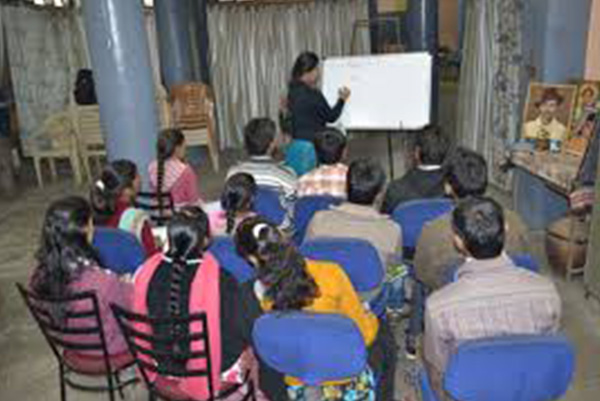
In the daily three-hour class, children would study and also learn values. But the path was not so easy. The parents of children living in the slum cluster are often illiterate, and both work as laborers. Because of this, they are not aware or vigilant about education. They are unable to motivate their children towards education, nor do they send them to study. Now, the problem was how to bring the children to the center. In such a situation, the teacher who came to teach would first go door-to-door in the slum to call the children and bring them, then she would teach.
In the beginning, many problems were faced. For example, the children would not come to study on their own, they would get up and run away in the middle, they would fight with each other, and they lived in filth. Once, a teacher, sharing her experience, said that some children wouldn't bathe for 4-5 days. In such cases, the children who came well-bathed and dressed would not like to sit with those dirty children. Complaints of this kind came frequently, that there was a bad smell, the children hadn't bathed, they hadn't brushed their teeth. One day, I made the children who didn't bathe sit under the tap, applied soap, and bathed them well, and said, 'If you don't come bathed tomorrow, I will bathe you in front of everyone again.' After that, all the children started coming daily, bathed and wearing clean clothes. This was the first change brought by Sewa Bharti's efforts. There are many such examples that brought about change in the slums and among the people of the slums.
Today, due to Sewa's efforts, primary education has expanded even in the sewa bastis (service slums). Sewa Bharti is playing the role of a bridge between preliminary and formal education. As a result, the people of the sewa bastis now seem eager to send their children to school.
Currently, through 119 centers for Balwadi and Bal Sanskar projects, a successful effort is being made every year to imbue 86,000 children with education, along with moral values, character building, and a spirit of patriotism. This is done so that in the future, the child can establish harmony with society along with their school education.
The center's daily routine teaches the child, as soon as they enter, to take off their slippers/shoes in a line, greet everyone with 'Namaste', and touch elders' feet to show respect. The daily prayer includes the Gayatri Mantra, Bhojan Mantra (mealtime prayer), Pratah Smaran (morning remembrance), Chaupaiyan (verses), and Shanti Path (peace prayer). Besides teaching from school books, stories of the bravery of great personalities and patriotic stories are also narrated daily. The children are also made to do some activity that they can do together, such as through sports or activities promoting social harmony like Sahbhoj (community meal), Havan (ritual), song competitions, etc. They are taught many such excellent ideas so that they can experience unity in diversity.
Children who study at Sewa Bharti centers get admission into any government school easily. The teacher herself goes and gets the center's children admitted. Once, when a teacher from the center went to get a child admitted to a school, the Principal said, 'The children who come from Sewa Bharti are very well-cultured. Seeing them, other children also behave like them. This is a matter of pride for us.'
The children who study at Sewa Bharti's centers show more self-confidence than other children. They learn very well how to express their thoughts comfortably in front of everyone, how to find a solution to any problem, and how difficult tasks can be done easily by working together. When these children come to us at the center to study, they are 3-4 years old. Some children don't even know how to speak properly. That is, they stay with us from the nursery level up to class eight. At some centers, coaching up to the tenth grade is also provided, but the sanskaar (values) aspect is compulsory for everyone.
This is the reason why even when some children grow up and are employed in good companies or run their own businesses, they remain connected to Sewa Bharti and are also active in social work. Many such boys and girls who have studied at Sewa Bharti's centers are committed to doing lifelong service work with us.
This means that the sapling which Sewa Bharti planted in the form of the sanskaar center has today taken the form of a banyan tree, making the whole environment fragrant and beneficial.